The world has become a little dimmer following the news of the passing of Kaleb, a young boy whose journey of monumental courage and unshakable optimism served as a beacon of light for millions. Known across the nation for his radiant smile and a level of poise that defied his years, Kaleb was more than just a face of a medical cause; he was a living testament to the power of the human spirit. Among those most deeply affected by this loss is legendary actor Denzel Washington, who has long been a quiet admirer of the boys resilience. As tributes pour in from every corner of the globe, the story of their connection and the legacy Kaleb leaves behind is reminding us all that true strength is not measured by physical stature, but by the depth of one’s heart.
Kaleb’s life was defined by a battle that began at birth. He was diagnosed with Osteogenesis Imperfecta, a rare genetic disorder characterized by extremely fragile bones that can break with little to no apparent cause. For most, the simple act of sneezing, rolling over in bed, or a gentle hug would be mundane parts of daily life. For Kaleb, these moments were fraught with danger. Throughout his short but impactful life, he endured more than 200 bone fractures. Each break brought not only immense physical agony but the grueling necessity of hospital stays, surgeries, and months of immobilization in casts and braces. To imagine a childhood spent largely within the sterile walls of medical wards is to imagine a life of shadow, yet Kaleb famously lived in the sun.
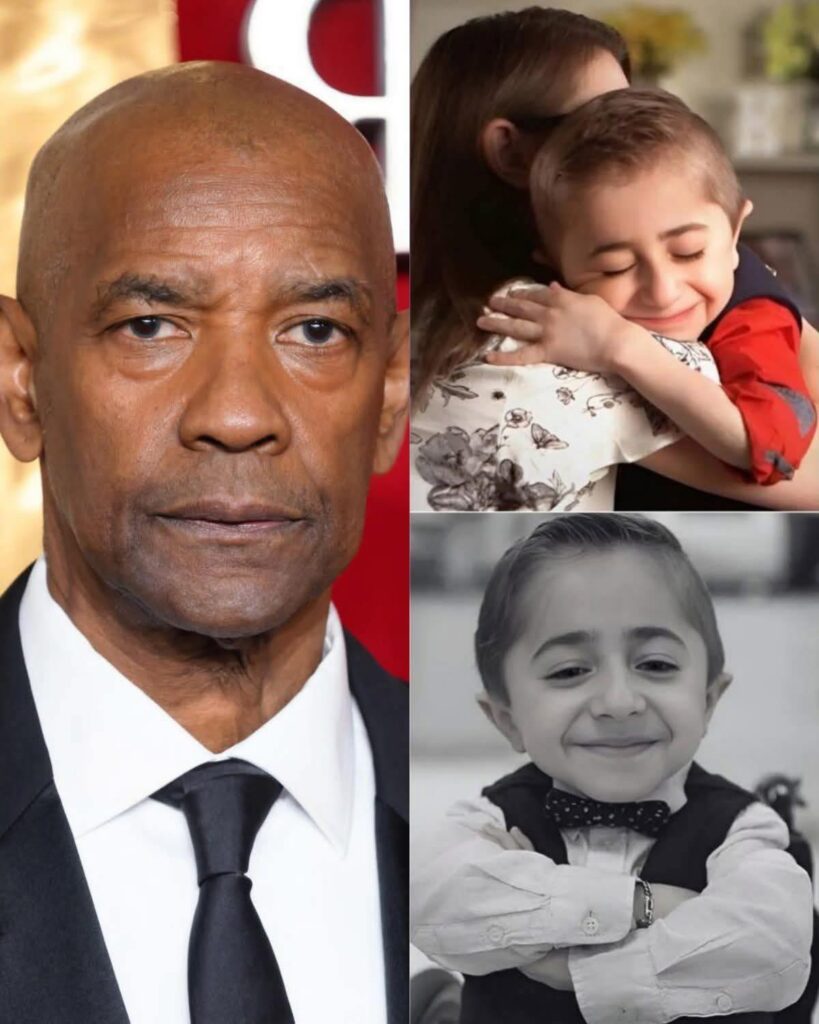
He refused to be a victim of his biology. Instead of retreating into the isolation that his condition could have easily dictated, Kaleb stepped into the spotlight. He became an ambassador and national spokesperson for Shriners Children’s, an organization that specializes in treating children with complex orthopedic conditions and rare diseases. It was through this platform that Kaleb’s voice reached the masses. He didn’t just ask for help; he offered hope. His appearances in awareness campaigns were never about pity. They were about a young man who looked into the camera with calm confidence and told the world that he was more than his diagnosis. He became a symbol of resilience for families who felt crushed by the weight of similar medical battles, proving that a diagnosis is not a destiny.
Denzel Washington’s involvement in this narrative highlights the profound emotional bridge Kaleb built between himself and the public. Washington, a man known for his deep Christian faith and his tendency to support humanitarian causes away from the prying eyes of the paparazzi, found himself moved by Kaleb’s journey. Those close to the situation suggest that Washington followed Kaleb’s progress for years, often citing the boy’s bravery as a source of personal reflection. In the wake of Kaleb’s passing, reports have surfaced regarding an emotional final message or gesture of prayer shared by the actor. Washington has frequently spoken in public forums about the necessity of spiritual fortitude, and his grief over Kaleb reflects a genuine bond formed through a shared understanding of struggle and the importance of grace under pressure.
The news of Kaleb’s departure has sparked a massive wave of mourning across social media and digital communities. Thousands of people who never met the boy in person are sharing how his videos and stories helped them through their own darkest hours. In a world often dominated by cynical news cycles, Kaleb represented a pure form of goodness. His legacy is now being cemented through the “Kaleb Effect,” a phenomenon where people are encouraged to approach their own obstacles with a fraction of the bravery he displayed daily. Online tributes are filled with images of his iconic smile—a smile that persisted even after the most painful surgeries or the most discouraging setbacks.
Beyond the personal grief of his family and supporters, Kaleb’s life has served a vital educational purpose. By being so open about his experiences with Osteogenesis Imperfecta, he brought international attention to a condition that is often misunderstood or overlooked. His work with Shriners Children’s helped secure funding and awareness that will benefit future generations of children born with “brittle bone disease.” He was a catalyst for change, ensuring that the specialized care he received would be accessible to others who might otherwise have no hope for a high quality of life. He turned his personal pain into a public service, a feat that many adults struggle to achieve in a full lifetime.
The bond between a Hollywood icon like Denzel Washington and a young boy like Kaleb speaks to the universal nature of inspiration. It reminds us that no matter how much fame or wealth one acquires, the most moving experiences in life come from witnessing the raw, unadulterated courage of a child facing the impossible. Washington’s reported reflection on Kaleb’s life serves as a call to action for the rest of us to value our health, our families, and our capacity to encourage one another. The actor’s heartbreak is a mirror for the collective sadness of a nation that grew to love a boy who taught us how to stand tall, even when his bones would not allow it.
As the world says its final goodbyes, the focus remains on the light Kaleb left behind. He proved that resilience is a choice made every single morning. He showed that a hospital bed could be a platform for global change and that a wheelchair could be a throne of influence. His story does not end with his passing; it continues in every family that finds the courage to keep fighting a rare disease, in every donor who supports pediatric research, and in every person who chooses to smile despite their circumstances. Kaleb was a giant in every way that truly matters, and while Denzel Washington and the rest of the world mourn his physical absence, his spirit remains an unbreakable force that will continue to inspire for decades to come.
In the final assessment of Kaleb’s life, it is clear that he was a teacher. He taught us that vulnerability and strength are not opposites, but two sides of the same coin. He taught us that a short life lived with purpose is far more powerful than a long life lived in indifference. As the community gathers to honor his memory, the message is clear: Kaleb may have been born with bones that could break, but he possessed a soul that was entirely invincible. His journey was a masterclass in the human capacity for joy, and his memory will forever be a reminder that even the smallest voice can echo across the entire world if it speaks with enough love and conviction.