The morning air was thick with the kind of hollow, suffocating silence that had taken up permanent residence in our home since Jonathan died. It was a silence that echoed off the walls, making the simple act of rinsing a cereal bowl feel like a monumental task. I stood at the kitchen sink, my gaze carefully averted from the small hook by the door where his keys still hung—a silver and leather ghost of a life that had been cut short far too soon. The sudden, shrill ring of the telephone shattered the quiet, and when I saw it was the principal of my twelve-year-old daughter Letty’s school, a cold spike of adrenaline shot through my veins.
Mr. Brennan didn’t offer the usual pleasantries. His voice was taut, vibrating with a frantic edge that sent my heart into a dizzying freefall. “You need to come in immediately,” he said. Three months ago, a different man in a different uniform had used those exact words to tell me that my husband’s heart had stopped beating at the manufacturing plant. As I grabbed my purse and raced to the car, my mind became a storm of terrifying possibilities. Mr. Brennan mentioned that six men in heavy work jackets had marched into the school lobby demanding to see my daughter by name. Security was on high alert, and the atmosphere was escalating toward a breaking point.
When I skidded into the school parking lot, I found the principal pacing outside the front office, his face a ghostly shade of pale. He explained that these burly, rough-handed men had refused to leave until they spoke with Letty. What shocked him most, however, was Letty’s reaction. Instead of being frightened by the sight of six strangers, she had heard them mention her father’s name and had firmly planted her feet in the office, refusing to go to class until she faced them. To understand the gravity of that moment, you have to understand the transformation that had occurred in our bathroom just twelve hours earlier.
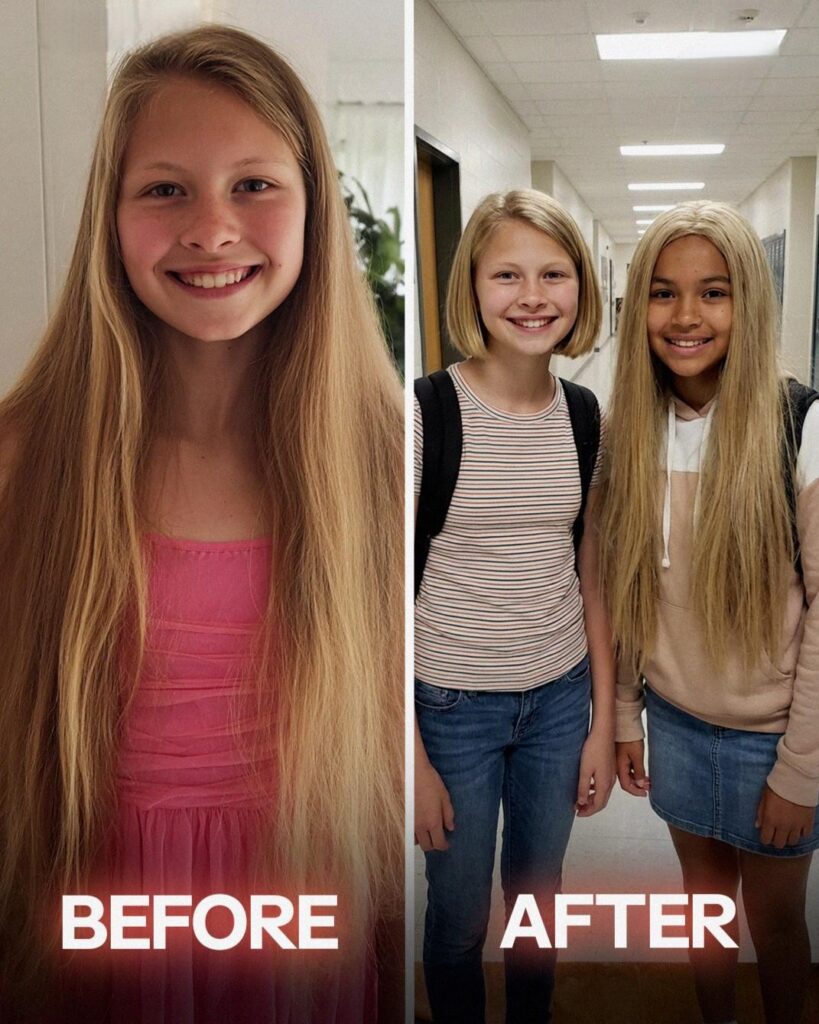
The night before, I had walked into the bathroom to find a sight that stopped my breath. The floor was covered in long, chestnut-colored locks of hair. Letty stood over the sink, kitchen scissors gripped in her trembling hand, holding a ribbon-tied bundle of her own hair. Her head was a jagged, uneven mess, the beautiful length she had spent years growing gone in an instant. My initial shock was met with her sobbing explanation. She told me about Millie, a quiet classmate in remission from cancer whose hair had grown back thin and patchy. Letty had overheard a group of boys in the science lab mocking Millie’s appearance, watching as the girl fled to the bathroom in tears.
Letty decided then and there that Millie shouldn’t have to feel “different” alone. She cut her hair to donate it for a wig, hoping a small sacrifice could mend a peer’s broken spirit. I couldn’t be angry. How could I? I remembered Jonathan’s final weeks, how his hair had fallen out in clumps on his pillow—a sight Letty had witnessed with a quiet, observant sorrow. I took the scissors from her, pulled her into a deep hug, and told her that her father would have been the proudest man on earth. That evening, we went to a local salon owned by Teresa, whose husband, Luis, had worked alongside Jonathan at the plant for over a decade. When Luis saw the ponytail on the counter and heard Letty’s reasoning, a profound look of recognition washed over his face. He told her she was truly her father’s daughter—a man who couldn’t stand to see people suffer in silence.
Now, as Mr. Brennan opened the door to the office, the pieces of a much larger story began to lock into place. The room was crowded and heavy with emotion. Letty was there, her eyes red from crying, standing beside Millie. Millie was wearing a beautiful, high-quality wig that Teresa must have stayed up all night to finish. Millie’s mother, Jenna, was weeping quietly in the corner, overwhelmed by the sudden outpouring of support. But the most striking sight was the six men standing in the center of the room. They were covered in the dust of the plant, their faces etched with the grime of a hard shift, but their eyes were soft. In the center of the principal’s desk sat a scuffed yellow hard hat with a glittery purple star stuck to the rim—a sticker Letty had placed there when she was five years old.
Luis stepped forward, his voice thick and gravelly. He explained that after we left the salon the previous night, he had called Marcus, Jonathan’s old supervisor. He told the crew what Jonathan’s little girl had done. These men hadn’t come to the school to cause trouble; they had come to fulfill a sacred promise. Marcus handed me a weathered, grease-stained envelope with my name written in Jonathan’s unmistakable, blocky handwriting. He revealed a secret Jonathan had kept at the plant: the “Keep Going Fund.”
When Jonathan first got sick, he saw how the staggering cost of cancer treatments could crush a family’s spirit. He started a collection in the break room, a “rainy day” fund for those facing the same battle. He had told his brothers at the plant that if he couldn’t be there to help people personally, they had to carry the torch for him. Marcus set a check on the desk—a sum gathered from years of small, sacrificial donations from the men who loved my husband. He turned to Millie’s mother and told her that the fund had finally found its rightful home. Jenna was speechless, staring at a financial lifeline that would allow her to focus on her daughter’s recovery instead of the mounting debt.
But the most devastating moment came when Marcus pulled a second note from his pocket, one Jonathan had left specifically for the men to read if the time ever came. The letter read: “If my girls ever forget what kind of man I tried to be, remind them by how you show up. Letty will always lead with her heart. Piper will pretend she’s fine and carry too much by herself. Don’t let either one of them stand alone.”
The silence that followed was absolute. I looked at the principal, who was wiping his eyes, completely moved by the display of blue-collar brotherhood. He informed us that the boys who had bullied Millie had been suspended and that the school was launching a new empathy initiative in Jonathan’s name. The “Keep Going Fund” would continue as a permanent district charity, ensuring no child would ever have to feel isolated or ashamed of their struggle.
When I finally opened my own envelope in the hallway, the words felt like Jonathan’s warm hand on my shoulder. He urged me not to close my heart out of fear and to let people in. Outside, the air felt different—lighter, as if a great weight had been lifted. The grief that had been a locked room for three months had finally found a door. I approached Jenna and Millie, insisting they come over for dinner. I knew every trick for feeding a child who had lost their appetite to chemo, and I wasn’t going to let them walk that path alone.
On the drive home, Letty sat in the passenger seat, clutching her father’s yellow hard hat. She asked if I thought Dad would have cried today. I smiled through my tears and told her that he absolutely would have—and then he would have spent the rest of the week lying about it to his friends. Jonathan hadn’t walked through our front door that afternoon, but through our daughter’s courage and the loyalty of the men he worked with, his love had found its way back to us. The house didn’t feel empty anymore. The keys were still on the hook, but they were no longer a reminder of a loss; they were a symbol of a legacy that Letty was already carrying forward with every beat of her heart.