Across Arizona, something unsettling is happening beneath the surface. It isn’t dramatic like an earthquake, and it doesn’t arrive with sirens or shaking ground. Instead, the land simply gives way. One day a driveway is intact. The next, it’s split open by a jagged crack wide enough to swallow a tire. Walls tilt. Roads fracture. Fields tear apart. What once felt solid suddenly isn’t.
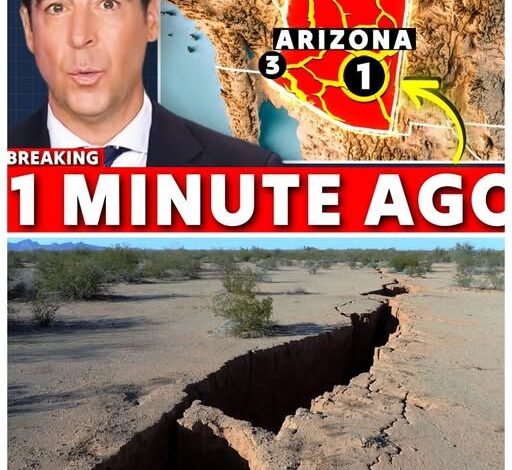
These are earth fissures, and they are quietly spreading across Arizona’s fastest-growing regions.
At first glance, the state still looks like a success story. Phoenix, Tucson, and surrounding suburbs continue to expand. New homes rise in former farmland. Distribution centers and highways stretch farther into the desert. Population growth remains strong, and development rarely slows. But underneath that growth, the ground is literally collapsing.
The cause isn’t tectonic movement. It’s water—or rather, the lack of it.
For decades, Arizona has relied heavily on groundwater to fuel its cities, agriculture, and industry. Aquifers that formed over thousands of years have been pumped at a pace far faster than nature can replace. When water is removed from underground layers of sediment, those layers compact. Once they compress, they don’t rebound. The result is land subsidence: the gradual sinking of the earth’s surface.
Earth fissures are the most violent expression of that process.
As the ground settles unevenly, tension builds until the surface splits apart. These fissures can stretch for miles, slicing through desert, farmland, neighborhoods, and infrastructure. Some are only inches wide. Others open into gaping trenches several feet across and dozens of feet deep. They often form suddenly, without warning, and once they appear, they never truly heal.
For homeowners, the damage can be devastating.
Entire houses have been rendered unlivable by cracks running straight through foundations. Garages separate from homes. Interior walls fracture. Insurance coverage is inconsistent, and repairs can cost tens or even hundreds of thousands of dollars. In many cases, the land itself is permanently compromised, leaving owners with property that cannot safely be rebuilt.
Farmers face their own losses. Irrigation systems snap. Fields become uneven and dangerous for equipment. In some areas, fissures cut directly across cropland, forcing farmers to abandon productive acreage. Roads and canals are also vulnerable, and when buried utilities are severed, the costs ripple outward to entire communities.
Scientists can track where fissures are likely to appear. They can map subsidence, measure groundwater loss, and model future risk zones. What they cannot do is reverse the damage. Once an aquifer collapses, the underground structure that supported the land is gone forever.
That reality leaves Arizona facing uncomfortable choices.
Much of the state’s growth has been built on the assumption that water can always be found somewhere else—deeper wells, new pipelines, imported supplies. But fissures expose the limits of that thinking. They mark places where the land has already crossed a point of no return.
In rural areas, fissures have been known for years. But increasingly, they are appearing closer to major population centers. Suburbs that once felt safely removed from desert hazards are now discovering that growth itself has amplified the risk. The more groundwater that is pumped to support development, the more unstable the land becomes.
Policy has struggled to keep pace.
Arizona’s groundwater laws vary sharply by region. Some areas operate under strict management plans. Others face few meaningful limits on pumping. Developers can legally build in zones where subsidence is already documented, leaving future homeowners to absorb the consequences. Disclosure requirements exist, but they don’t always convey the scale of long-term risk.
Critics argue that fissures are not just geological failures, but regulatory ones.
They reveal a system that prioritizes short-term growth over long-term stability. Every new crack in the ground mirrors a crack in planning, enforcement, and political will. The damage is slow, but cumulative—and unlike many environmental problems, it cannot be undone with technology later.
Communities that have been hit hardest often feel blindsided. Residents describe the shock of watching the earth open near their homes with no prior indication. Many say they were never warned that the land beneath them was unstable. Others assumed fissures were a distant desert problem, not something that could reach suburban streets.
The psychological toll is real. Living on ground that may continue to shift creates constant anxiety. Even after repairs, homeowners know the fissure is still there, waiting. Property values can drop overnight, trapping families financially. Selling becomes difficult. Staying feels risky.
From a scientific standpoint, the warning signs are clear.
Groundwater levels across large portions of Arizona have fallen hundreds of feet in some areas. Satellite data shows measurable land sinking year after year. Fissure maps grow longer and denser with each update. The trend line points in one direction.
The question is not whether fissures will continue to appear. It’s where—and how close to critical infrastructure and dense populations they will reach.
Some experts argue that the state must begin drawing firm boundaries: areas where development is no longer permitted, regardless of economic pressure. Others emphasize aggressive groundwater conservation, recharge projects, and urban redesign to reduce demand. None of these solutions are easy, and all come with political and financial costs.
But the alternative is building on borrowed ground.
Every subdivision placed atop a shrinking aquifer is a bet against physics. Earth fissures don’t negotiate. They don’t pause for economic cycles. They simply follow the path carved by decades of extraction.
Arizona’s deserts have always demanded respect. For centuries, survival here depended on understanding limits—of water, heat, and land. Modern engineering made it possible to push those limits, but fissures are proof that some boundaries still exist.
The cracks spreading across the state are not sudden disasters. They are slow, visible consequences of long-term decisions. Each fracture tells the same story: when water disappears, the land remembers.
Arizona can still adapt. Smarter water management, stricter development rules, and honest communication about risk could stabilize the future. But adaptation requires acknowledging reality, not outrunning it.
The ground is already breaking open. The only remaining question is whether policy and planning will close the gap—or continue widening it until the damage becomes impossible to ignore.