In the frantic, high-definition blur of the twenty-first century, it is increasingly rare to experience a moment that demands our absolute, undivided presence. We are a society of multitaskers, forever tethered to the digital hum of our pockets, often ignoring the profound narratives unfolding in our own backyards. Yet, there is one small creature capable of piercing through this noise with a single, iridescent flash of its wings: the hummingbird. Across countless cultures, disparate geographies, and many generations, the sudden appearance of a hummingbird at one’s home is rarely dismissed as a mere biological coincidence. Instead, it is greeted as a visitation—a small, feathered messenger carrying a spiritual weight that far exceeds its literal mass.
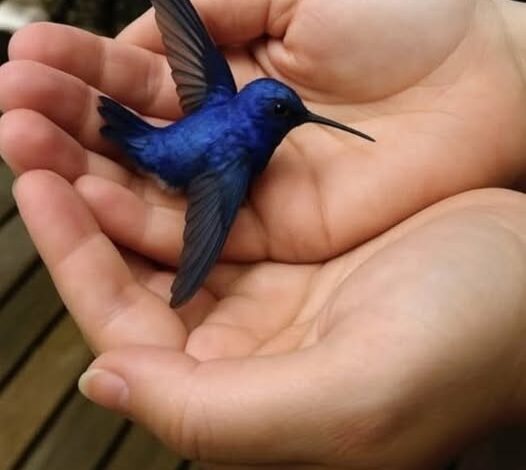
To understand why a hummingbird’s visit is considered so special, one must first appreciate the staggering biological defiance of the bird itself. Weighing less than a nickel and capable of flapping its wings up to eighty times per second, the hummingbird lives on the razor’s edge of the impossible. Its heart beats over a thousand times per minute, and its metabolism is so demanding that it must consume more than its body weight in nectar every single day just to survive the night. When such a high-velocity miracle chooses to pause at your window or hover inches from your face in a quiet garden, it creates a “stillness inside movement” that is almost hypnotic.
In many Indigenous traditions throughout the Americas, the hummingbird is revered as a sacred being, a harbinger of blessing and renewal. For the Navajo, the hummingbird is a symbol of beauty and integrity; for the Aztecs, they were the reincarnated souls of fallen warriors. When a hummingbird arrives at a home today, many still interpret it as a sign that stagnant energy is being cleared away. It is seen as a gentle nudge from the universe that renewal is not only possible but imminent. Their presence suggests that good news is on the horizon and that the “heaviness” of a difficult season is finally beginning to lift. It is an invitation to open a new door in one’s life, even if that door is simply a mental shift toward optimism.
Beyond the cultural lore of renewal, there is a deeply personal, emotional layer to these visitations. For those navigating the hollow landscape of grief, a hummingbird’s visit often feels like a bridge to the beyond. It is a common phenomenon for people to report a hummingbird appearing shortly after the loss of a loved one, or on a significant anniversary of a passing. While skeptics may point to the seasonal patterns of migration, for the person standing at the window, the timing feels precise and intentional.
In this context, the hummingbird becomes a symbol of the enduring nature of love. Its ability to hover—to stay perfectly suspended in mid-air while the world moves around it—serves as a metaphor for a love that remains fixed even after the physical presence of a person has departed. Many people find a profound sense of reassurance in these moments, viewing the bird’s shimmering colors and sudden proximity as a soft whisper from a lost parent, spouse, or friend. It is a reminder that while the form of the relationship has changed, the connection is still woven into the fabric of the present. The message is simple but powerful: you are not forgotten, you are not alone, and love is a force that transcends the boundary of death.
There is also a significant psychological benefit to the presence of these birds, often referred to as “nature’s therapy.” In the field of ecopsychology, researchers have long noted that observing small, intricate wildlife can trigger a physiological state of “soft fascination.” Unlike the “hard fascination” required to navigate a computer screen or heavy traffic—which eventually leads to mental fatigue—soft fascination allows the mind to rest while the eyes remain engaged. When we watch a hummingbird, we are forced to slow down our own internal rhythm to match its delicate hovering. We become observers of the minute, noticing the way light refracts off its gorget feathers or the way it deftly navigates a flower’s bloom.
This act of observation is a call to return to the present moment. In a world characterized by “future-anxiety” and “past-regret,” the hummingbird exists only in the now. It cannot afford to be anywhere else. Its visit serves as a spiritual nudge to step out of the stress of our to-do lists and return to a state of gratitude. It invites us to savor what is simple and nourishing, reminding us that life—much like the bird itself—is precious, fleeting, and vibrant.
For those who wish to invite this “special meaning” into their lives, the act of creating a sanctuary for hummingbirds is a rewarding endeavor. By planting native, tubular flowers like honeysuckle, bee balm, or sage, homeowners can transform a simple yard into a spiritual crossroads. The effort required to maintain a clean feeder and a pesticide-free environment is a form of stewardship that connects us back to the land. When we take care of the hummingbird, we find that the hummingbird, in its own way, takes care of us.
The significance of the hummingbird lies in its role as a mirror. It reflects our own capacity for resilience, our need for beauty, and our desire for connection. Whether you view its visit through the lens of ancient tradition, personal remembrance, or simple biological appreciation, the effect is the same: the heart is softened. We are reminded that magic doesn’t require grand spectacles; sometimes, it arrives in a creature no larger than a thumb, hovering on wings of impossible speed.
Ultimately, a hummingbird’s visit is a testament to the fact that the world is still capable of surprising us. It is a small spiritual intervention that asks us to orient our hearts toward joy. It tells us that even the smallest life can have the greatest impact, and that sometimes, the most important messages are the ones delivered without a single word. When a hummingbird comes to your home, it isn’t just a bird passing through; it is an invitation to see the world—and your own life—with a renewed sense of wonder and meaning.